

.png)
Industrial Ethernet networks are no longer passive infrastructure layers that simply move control data from point A to point B. The convergence of OT and IT, the growing use of edge analytics and machine vision, and increasing regulatory and cybersecurity expectations are reshaping how industrial networks are specified, deployed, and operated.
In many environments, Ethernet is no longer used only for cyclic control traffic. It now carries a mix of time-sensitive control data, high-volume sensor telemetry, machine vision streams, and analytics outputs—often over the same physical network. This shift places fundamentally different demands on network design.
Modern industrial platforms must now support:
Deterministic real-time performance
High-bandwidth data aggregation
Intelligent and reliable power delivery
Native OT cybersecurity
Long lifecycle and supply-chain transparency
These requirements are difficult to satisfy with repurposed enterprise networking equipment. Industrial environments impose constraints on timing, reliability, environmental robustness, and operational continuity that require purpose-built architectures.
Table of Contents:

As robotics, motion control, digital substations, and synchronized production systems become more common, traditional best-effort Ethernet reaches its limits. Even with VLANs and QoS, conventional Ethernet cannot guarantee bounded latency or eliminate jitter under heavy or unpredictable load.
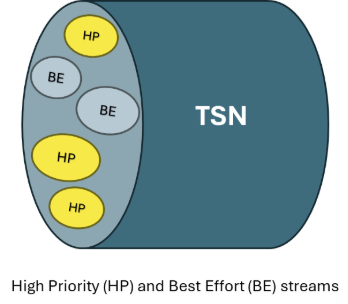
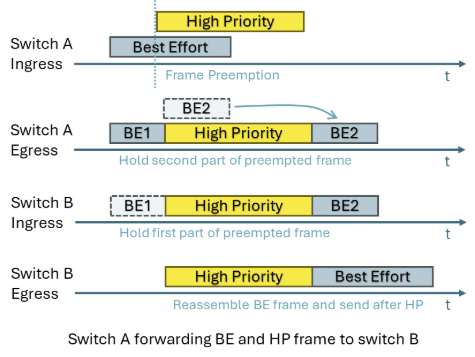
Time-Sensitive Networking (TSN) enables bounded latency, low jitter, and precise synchronization across converged networks by defining dedicated streams for high-priority data flows that can preempt best effort traffic.
This becomes especially relevant as AI and machine learning workloads move closer to the edge. Unlike classical control traffic, AI-related data often exhibits very different characteristics: sustained high-bandwidth streams from vision systems, burst transmissions driven by inference cycles, and variable packet sizes depending on compute behavior.
On conventional Ethernet, this variability manifests as queue growth, jitter, and tail latency. In mixed IT/OT networks, such effects can directly impact motion control stability, safety functions, and synchronized operations.
TSN addresses this by creating predictable communication behavior at the network layer. A typical TSN-capable industrial switch supports:
IEEE 802.1AS (gPTP) for sub-microsecond time synchronization
IEEE 802.1Qbv for time-aware traffic scheduling
IEEE 802.1Qci for per-stream filtering and policing
IEEE 802.1CB for frame replication and elimination
Together, these mechanisms allow deterministic control traffic and high-volume data streams to coexist on the same physical network without interfering with each other.
From an AI system perspective, TSN provides two critical properties:
Timing integrity – AI decisions that feed back into control loops require bounded and repeatable latency. TSN ensures that inference outputs arrive within predictable timing envelopes.
Time coherence – Many industrial AI use cases rely on correlating data from multiple sensors, cameras, or subsystems. Precise clock synchronization improves timestamp alignment and enables accurate temporal modeling.
In practice, TSN is not simply a performance enhancement. It is an architectural enabler that makes converged, data-intensive industrial systems viable without sacrificing real-time behavior.

Single-Pair Ethernet enables Ethernet communication over a single twisted pair, supporting long cable distances while significantly reducing cabling volume, connector size, and installation complexity. This makes SPE particularly suitable for extending Ethernet deeper into the field layer, where space, weight, and cost constraints are more pronounced.
In factory environments, SPE enables Ethernet-native connectivity for:
sensors and condition monitoring devices
actuators and compact controllers
distributed I/O modules
SPE allows sensors, actuators, compact controllers, and distributed I/O modules to connect directly to IP-based control networks. This simplifies system architecture and enables consistent data models from the field layer up to higher-level systems.
In building automation and infrastructure applications, SPE simplifies IP connectivity for:
HVAC controllers
lighting systems
access control and energy management
Combining power and data over a single pair reduces cabling complexity and supports scalable deployment of distributed endpoints.
In practice, connector ecosystems for SPE are still evolving across device categories. In many deployments, terminal-style termination offers practical flexibility, particularly in retrofit scenarios or where reuse of existing cabling is required.
SPE does not replace traditional Ethernet backbones. Instead, it complements them by extending Ethernet to the edge while relying on standard Ethernet aggregation layers.
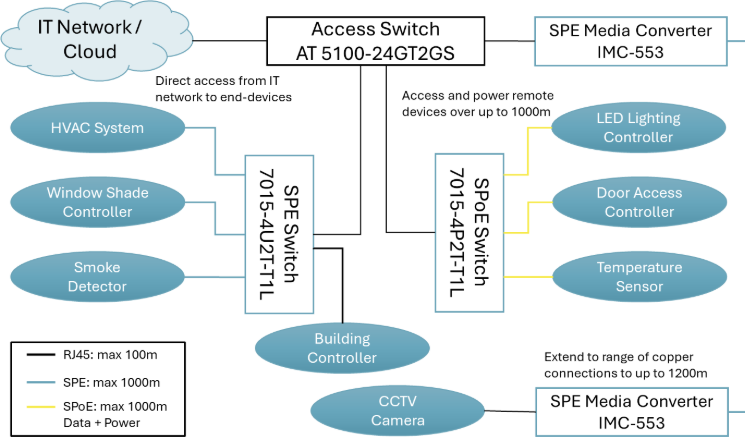
Across both domains, terminal block connectors offer tangible advantages. Since the market has not yet converged on a commonly used connector type, using terminal block connectors allows for more flexibility for connecting current and future SPE devices. Furthermore, terminal blocks are especially attractive for building automation as they allow for easy reuse of existing cabling.
Learn more about Volktek's Single-Pair Ethernet Solutions:
Single Pair Ethernet Switch 7015-4U2T-T1L
Single Pair Ethernet Media Converter IMC-553
Subscribe to learn about Volktek's upcoming SPoE (Single Pair PoE) Solutions

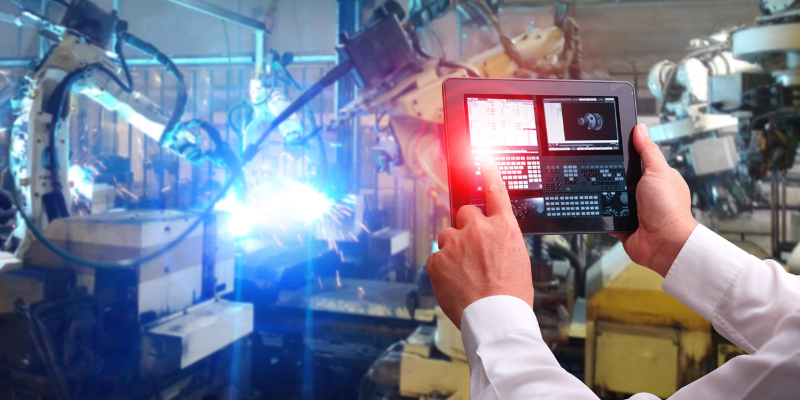
Industrial traffic profiles are changing rapidly. The integration of machine vision, AI-based inspection, and high-resolution sensing introduces sustained high-throughput data streams that quickly exceed the capacity of 1G aggregation links.
Typical drivers include multi-camera vision systems, robotic guidance, AI-based defect detection, and continuous telemetry aggregation from distributed devices.
In converged networks, control traffic, operational data, video streams, and IT traffic often share the same aggregation paths. Without sufficient headroom, congestion at the uplink layer becomes a direct threat to deterministic performance.
10G uplinks provide structural bandwidth margin. Rather than simply increasing peak throughput, they reduce queue growth, minimize microbursts, and preserve timing integrity for time-critical traffic.
10G Uplink Industrial Uplink Solutions:
PoE Version: 9560-16GP4XS-I
Non-PoE & NEMA-TS2 certified: 9560-16GT4XS-I

(1).png)
.png)
As edge devices become more capable, their power requirements increase accordingly. Modern industrial endpoints often integrate onboard processing, PTZ mechanisms, infrared illumination, environmental controls, and wireless radios.
Advanced industrial and infrastructure-grade cameras, for example, frequently include heaters, cooling elements, and ruggedized enclosures to ensure reliable operation in harsh environments. These features significantly increase power demand compared to earlier generations of devices.
IEEE 802.3bt (btPoE) delivers up to 90 W per port, enabling a single Ethernet cable to supply both high-speed data and sufficient power for advanced edge equipment such as AI-enabled cameras, wireless access points, industrial HMIs, and edge controllers.
Beyond raw power delivery, modern PoE management capabilities — including device health monitoring, scheduled power cycling, and intelligent power budgeting — allow centralized operational control of distributed edge systems. This reduces the need for local power infrastructure and simplifies maintenance in large-scale deployments.
In this sense, btPoE becomes part of the network architecture itself, not just a convenience feature.
Volktek's IEEE 802.3bt PoE solutions:
Managed PoE Switch: 9060-4GP2GS Series
60W PoE Injector: IPI-432P-60-I
90W PoE Injector: IPI-442P-90-I
Industrial cybersecurity cannot be treated as a simplified version of enterprise IT security. OT environments operate under fundamentally different constraints, including long system lifecycles, legacy protocols without native encryption, real-time availability requirements, and strong safety and continuity priorities.
Effective OT security architectures focus on containment and segmentation rather than pure perimeter defense.
Key architectural elements include:
protocol-aware inspection for industrial traffic
application allowlisting and role-based access control
secure remote access mechanisms
network segmentation and micro-perimeter enforcement
Modern OT security increasingly relies on coordinated architectures, where network devices and security platforms exchange state and enforce policies collaboratively. This enables real-time isolation of compromised assets while preserving operational continuity for unaffected segments.
The objective is not only detection, but deterministic containment with minimal operational disruption.
Subscribe to learn about Volktek‘s Next Generation Firewall engineered specifically for OT.



Volktek is also recognized as one of the leading suppliers of DNV-certified industrial Ethernet switches, widely deployed in maritime and offshore environments. Its DNV-approved portfolio supports:
Commercial and naval vessels
Offshore platforms
Port and harbor infrastructure
Maritime and offshore environments represent some of the most demanding conditions for industrial networking:
continuous vibration and mechanical stress
high humidity and salt exposure
temperature extremes
strong electromagnetic interference
Networking platforms certified for such environments must meet stringent mechanical and environmental requirements while maintaining reliable operation.
As a result, maritime and offshore deployments serve as real-world stress tests for industrial networking architectures under extreme physical conditions.
Explore Volktek’s DNV solutions here- VOLKTEK

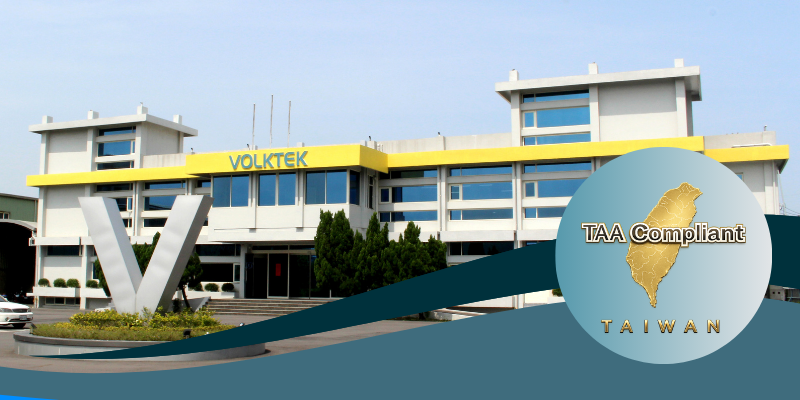
Beyond technical performance, industrial buyers increasingly evaluate networking platforms based on supply-chain transparency, regulatory compliance, long-term support, and cybersecurity posture. These factors have become critical design considerations, particularly for deployments in government, critical infrastructure, and regulated industrial environments.
One of the most significant regulatory developments is the European Union’s Cyber Resilience Act (CRA), which is setting new expectations for secure product development, vulnerability management, and lifecycle security across connected devices. While the CRA originates in Europe, its impact extends globally, as many cybersecurity frameworks and procurement standards are expected to align with or reference similar requirements over time.
At the same time, many industrial and government projects require country-of-origin traceability, controlled manufacturing environments, long-term product availability, and secure development and patch management processes.
From an engineering and operational perspective, these requirements place growing emphasis on vertical integration and supply-chain control. In-house hardware design, firmware development, and manufacturing enable tighter governance over component sourcing, quality assurance, security hardening, and long-term maintainability.
In addition, compliance with frameworks such as TAA and NDAA has become a practical prerequisite for many government and infrastructure projects, reinforcing the importance of transparent manufacturing origins and controlled production environments.
This level of integration directly impacts system reliability, cybersecurity posture, and operational continuity, providing faster root-cause analysis, shorter response cycles, and direct engineering-level support in mission-critical environments.

Industrial networking infrastructure is a long-term investment. Unlike enterprise IT, where refresh cycles are measured in years, industrial networks are expected to operate reliably for decades.
Technologies such as TSN, SPE, 10G Ethernet, btPoE, and OT-native cybersecurity are no longer optional innovations. They are foundational building blocks for current and future industrial systems.
Volktek’s approach is to engineer industrial networking platforms where determinism, scalability, security, and long-term support are fundamental design principles, enabling predictable and resilient operation across evolving industrial environments.
Subscribe to learn about Volktek‘s upcoming SPoE (Single Pair PoE) Solutions
|

